Love In Balance
There is a profound distortion woven deeply into the collective consciousness that few people ever stop to examine.
It is the belief that those who dedicate their lives to nurturing, healing, teaching, caregiving, mothering, guiding, and holding space for the growth and well-being of others should somehow be expected to do so at the expense of themselves.
Throughout history, the feminine has often been conditioned to measure her worth through sacrifice. She has been praised for how much she can endure, how much she can carry, how much she can give, and how much of herself she can offer to others before finally tending to her own needs. Generations of women have inherited the unconscious belief that receiving is selfish while giving is noble. That depletion is virtuous. That exhaustion is evidence of love. That their value is proven through how much they are willing to sacrifice for everyone around them.
Yet when we observe nature itself, we discover a very different truth.
The feminine principle was never designed to function through chronic depletion. The Earth receives the seed before it creates life. The womb receives before it nurtures. The flower receives sunlight before it blooms. Every creative force within nature operates through a sacred balance of giving and receiving. Creation itself emerges through reciprocity.
Somewhere along the way, however, humanity began glorifying imbalance.
Women were taught to give endlessly. Mothers were expected to pour from cups that were rarely replenished. Caregivers were praised for their selflessness while their own needs went unnoticed. Healers, teachers, and guides were often expected to offer their gifts freely while those benefiting from those gifts rarely considered the years of dedication, sacrifice, study, investment, and personal transformation that made those gifts possible in the first place.
This same pattern continues today.
People will readily invest money into entertainment, distractions, conveniences, luxury items, temporary pleasures, and countless forms of external consumption without questioning the exchange. Yet when someone invests years of their life developing the capacity to facilitate healing, transformation, wisdom, emotional integration, or spiritual growth, many suddenly become uncomfortable when compensation enters the conversation.
This discomfort reveals something important.
It is rarely about money.
It is often about our relationship with value.
Many people have unconsciously learned to value what entertains them more than what transforms them. They have learned to normalize paying for distractions while questioning the worth of the very things that could profoundly alter the trajectory of their lives.
The deeper irony is that many of the individuals who carry the greatest capacity to support transformation have often walked through initiations that cannot be quantified. Years of study. Years of personal healing. Years of trial and error. Years of learning to navigate suffering, trauma, loss, awakening, integration, and profound inner transformation. They have invested emotionally, mentally, physically, financially, and spiritually into becoming capable of holding others through similar journeys.
Yet society frequently sees only the session, the conversation, the offering, the post, the service, or the container being presented. It rarely sees the decades that made it possible.
This is particularly true for women.
The emotional labor women contribute to families, communities, businesses, relationships, and society itself has historically been undervalued precisely because it is so freely given. Mothers spend countless sleepless nights nurturing children who eventually become functioning members of society. Women often become the emotional anchors of entire family systems. They carry invisible responsibilities that cannot be measured by traditional metrics, yet these contributions form the foundation upon which healthy communities are built.
No amount of money could ever fully compensate a mother for every sacrifice she makes on behalf of her children. No amount of money could ever truly compensate the emotional labor, presence, intuition, wisdom, and care that women contribute to the world. Yet this reality should not be used as justification for expecting their labor to be free.
The fact that something is sacred does not mean it lacks value.
The fact that something is a calling does not mean it should require self-sacrifice.
The fact that someone genuinely loves serving others does not mean they should be expected to abandon their own needs in the process. Energy exchange is not greed.
Energy exchange is balance.
Reciprocity is one of the fundamental principles through which all healthy systems operate. When giving and receiving exist in harmony, life flourishes. When one side continually gives while the other continually takes, imbalance inevitably emerges.
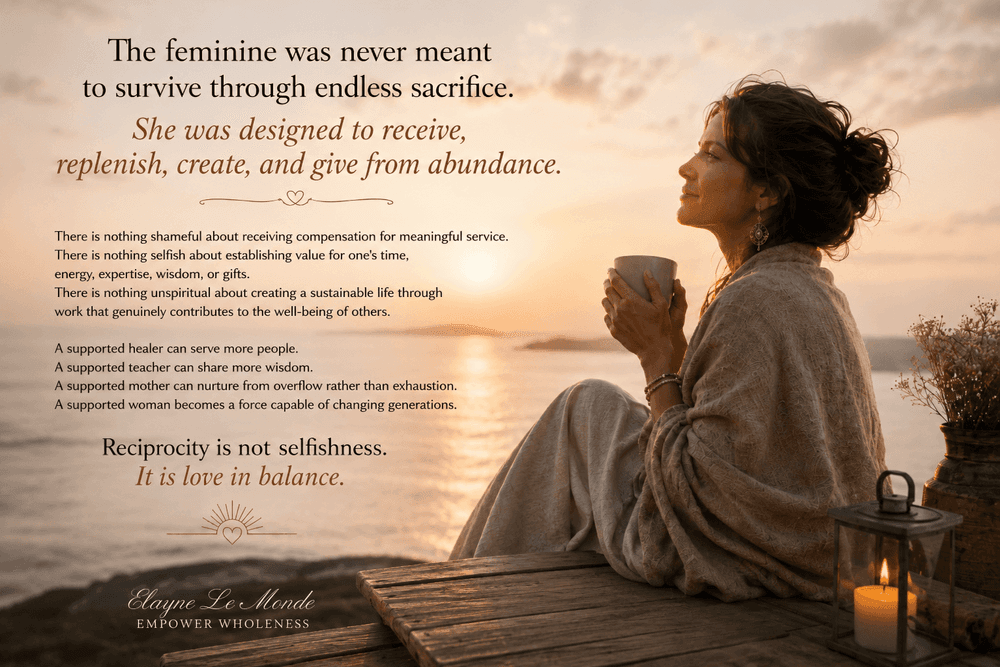
This is why there is nothing shameful about receiving compensation for meaningful service. There is nothing selfish about establishing value for one's time, energy, expertise, wisdom, or gifts. There is nothing unspiritual about creating a sustainable life through work that genuinely contributes to the well-being of others.
In truth, the individuals who help others heal, grow, awaken, and transform should be among the most supported members of society, not among the most criticized. A supported healer can serve more people.
A supported teacher can share more wisdom.
A supported mother can nurture from overflow rather than exhaustion.
A supported woman becomes a force capable of changing generations.
Perhaps the deeper question is not why someone asks to receive value for their contribution.
Perhaps the deeper question is why so many people have been conditioned to believe that the people who nourish the world should do so while remaining perpetually depleted themselves.
The feminine was never meant to survive through endless sacrifice.
She was designed to receive, replenish, create, and give from abundance.
And perhaps one of the most important collective healings of our time is remembering that reciprocity is not selfishness.
It is love in balance.
It is the belief that those who dedicate their lives to nurturing, healing, teaching, caregiving, mothering, guiding, and holding space for the growth and well-being of others should somehow be expected to do so at the expense of themselves.
Throughout history, the feminine has often been conditioned to measure her worth through sacrifice. She has been praised for how much she can endure, how much she can carry, how much she can give, and how much of herself she can offer to others before finally tending to her own needs. Generations of women have inherited the unconscious belief that receiving is selfish while giving is noble. That depletion is virtuous. That exhaustion is evidence of love. That their value is proven through how much they are willing to sacrifice for everyone around them.
Yet when we observe nature itself, we discover a very different truth.
The feminine principle was never designed to function through chronic depletion. The Earth receives the seed before it creates life. The womb receives before it nurtures. The flower receives sunlight before it blooms. Every creative force within nature operates through a sacred balance of giving and receiving. Creation itself emerges through reciprocity.
Somewhere along the way, however, humanity began glorifying imbalance.
Women were taught to give endlessly. Mothers were expected to pour from cups that were rarely replenished. Caregivers were praised for their selflessness while their own needs went unnoticed. Healers, teachers, and guides were often expected to offer their gifts freely while those benefiting from those gifts rarely considered the years of dedication, sacrifice, study, investment, and personal transformation that made those gifts possible in the first place.
This same pattern continues today.
People will readily invest money into entertainment, distractions, conveniences, luxury items, temporary pleasures, and countless forms of external consumption without questioning the exchange. Yet when someone invests years of their life developing the capacity to facilitate healing, transformation, wisdom, emotional integration, or spiritual growth, many suddenly become uncomfortable when compensation enters the conversation.
This discomfort reveals something important.
It is rarely about money.
It is often about our relationship with value.
Many people have unconsciously learned to value what entertains them more than what transforms them. They have learned to normalize paying for distractions while questioning the worth of the very things that could profoundly alter the trajectory of their lives.
The deeper irony is that many of the individuals who carry the greatest capacity to support transformation have often walked through initiations that cannot be quantified. Years of study. Years of personal healing. Years of trial and error. Years of learning to navigate suffering, trauma, loss, awakening, integration, and profound inner transformation. They have invested emotionally, mentally, physically, financially, and spiritually into becoming capable of holding others through similar journeys.
Yet society frequently sees only the session, the conversation, the offering, the post, the service, or the container being presented. It rarely sees the decades that made it possible.
This is particularly true for women.
The emotional labor women contribute to families, communities, businesses, relationships, and society itself has historically been undervalued precisely because it is so freely given. Mothers spend countless sleepless nights nurturing children who eventually become functioning members of society. Women often become the emotional anchors of entire family systems. They carry invisible responsibilities that cannot be measured by traditional metrics, yet these contributions form the foundation upon which healthy communities are built.
No amount of money could ever fully compensate a mother for every sacrifice she makes on behalf of her children. No amount of money could ever truly compensate the emotional labor, presence, intuition, wisdom, and care that women contribute to the world. Yet this reality should not be used as justification for expecting their labor to be free.
The fact that something is sacred does not mean it lacks value.
The fact that something is a calling does not mean it should require self-sacrifice.
The fact that someone genuinely loves serving others does not mean they should be expected to abandon their own needs in the process. Energy exchange is not greed.
Energy exchange is balance.
Reciprocity is one of the fundamental principles through which all healthy systems operate. When giving and receiving exist in harmony, life flourishes. When one side continually gives while the other continually takes, imbalance inevitably emerges.
This is why there is nothing shameful about receiving compensation for meaningful service. There is nothing selfish about establishing value for one's time, energy, expertise, wisdom, or gifts. There is nothing unspiritual about creating a sustainable life through work that genuinely contributes to the well-being of others.
In truth, the individuals who help others heal, grow, awaken, and transform should be among the most supported members of society, not among the most criticized. A supported healer can serve more people.
A supported teacher can share more wisdom.
A supported mother can nurture from overflow rather than exhaustion.
A supported woman becomes a force capable of changing generations.
Perhaps the deeper question is not why someone asks to receive value for their contribution.
Perhaps the deeper question is why so many people have been conditioned to believe that the people who nourish the world should do so while remaining perpetually depleted themselves.
The feminine was never meant to survive through endless sacrifice.
She was designed to receive, replenish, create, and give from abundance.
And perhaps one of the most important collective healings of our time is remembering that reciprocity is not selfishness.
It is love in balance.